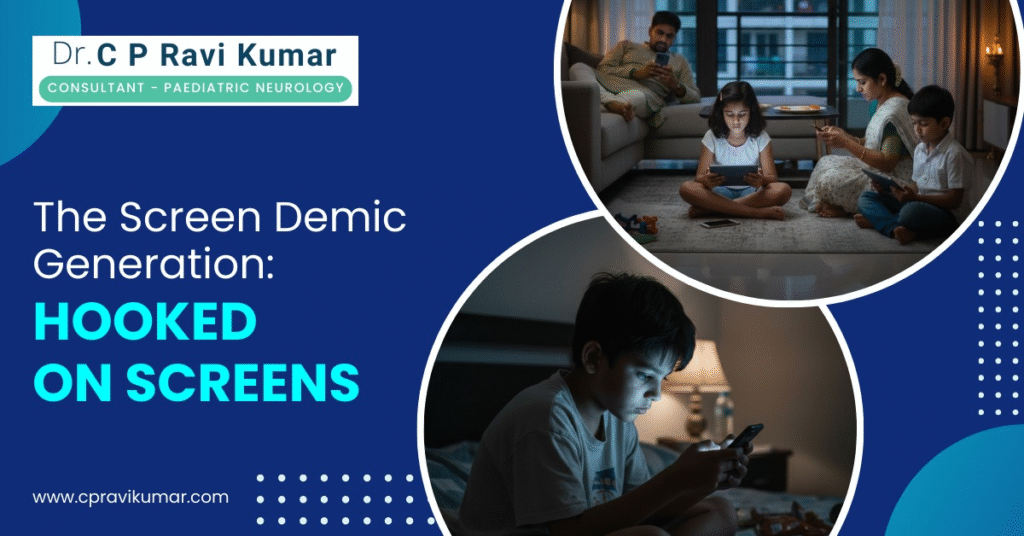
” Screen-demic” refers to an epidemic of mental health illness and negative effects of excessive screen time and social media usage, especially on children and adolescents, leading to severe problems with their mental health, developmental milestones and addiction. These days screen time seems to be all the time, more susceptible ones being the kids. Screen- demic is the term coined by consultant paediatrician in Leicester children’s hospital Dr. Sanjiv Nichani. Children are nowadays being exposed to gadgets from a very young age. However, during the covid pandemic, there was an increase in the number of hours spent on looking at the screen. It is also reported that there has been a 52% increase in screen time among children and adolescents during the pandemic ( Sheri Madigan et al., 2022)
Dr. Sanjiv says: ” we are sleepwalking into significant mental health problems” because it has changed childhood completely from what used to be a play-based childhood, to a phone based childhood. Children and even some babies have a tantrum if the screen is taken away from them.
It is also the content, children are watching rather than the device itself making them screen – demic as the content they watch are driven by addictive algorithms , which is linked to releasing of an hormone called as dopamine, which makes you feel good, hence the providers have made the algorithm in such a way that you want to keep reaching out to your phone. If younger children and babies are stuck up with the screen all the time, they pay no attention to the vocabulary of friends and family, and this leads to poor interaction skills. Many studies are telling us that there are significant changes in the children’s brains. A very sophisticated scans are showing changes in the children’s brains from a very young age as well as teenagers who are spending hours and hours in front of a screen. Babies and toddlers watch cocomelon like shows and it does more harm than good . Experts warn that overstimulating content, like Watching the screen for longer time consumes a lot of energy and time. Nearly 4 in 10 children spend at least 3 hours a day on the device and are missing their family time. According to Mayo clinic, excessive screen time in kids has been linked to loss of social skills, behavioural problems, less sleep or irregular sleep, obesity and even violence.

There are impacts of excessive screen time on various aspects of life such as:
- Physical health : There is increasing evidence of a strong association between screen time and childhood obesity. According to a study conducted by( Chaudhry S. et al., 2019) gives a evidence that excessive screen time is linked to increased Adiposity and obesity in children. Looking at the screens during meals makes it hard for the child to sense fullness and they continue to eat.
- Mental health : The earlier a child has a smartphone the more they are struggling with their mental well being , ability to concentrate, focus, and learn at school. Noetel and his colleagues conducted a study to analyse the relationship between screen time and socioemotional problems, like aggression, anxiety , or self confidence. They included participants under 10 years of age and they were followed up for at least six months. Screen based activities included social media, video games, TV watching and online homework. Most of the studies were conducted in the United States ( 41 studies), followed by Canada (13), Australia (11), and both Germany and the Netherlands ( 7 each).
The analysis showed a clear pattern, the more time children spent on screens, the greater their chances of developing socioemotional difficulties. These included internalizing problems such as aggression and hyperactivity. At the same time, children who already struggled with these issues often turned to screens as a coping strategy.
Certain factors influenced these effects. Older children aged 6 to 10 years were more at risk than younger ones aged 0 to 5 years. Gender also mattered: girls were more likely to develop socioemotional problems with heavy screen use, while boys tended to increase screen time when experiencing emotional or behavioural struggles.
The type of screen activity made a difference too. Gaming was linked to greater risks compared with educational or recreational screen use. Children with existing socioemotional problems were especially prone to using games as a form of a escape.
- vision problems : An estimated 58% of people who work on computers experience computer vision syndrome, it has series of symptoms that include eyes strain, blurred vision, headaches, and neck and back pain, and in the long run the same amount of screen time can damage our vision permanently. Since 1971, cases of nearsightedness in the US have nearly doubled, which some scientists partly linked to excessive screen time. In Asia nearly 90% of teens and adults are nearsighted, but it is not just the brightness of the screen that affect us, it is also the colour. Screens emit a mix of red, green and blue light similar to sunlight. Our circadian rhythms are more sensitive to blue light than any others, this becomes an issue when we use our screens at night. when sun sets, we produce a hormone called as melatonin, which makes us feel tired and fall asleep, and blue light from screens disrupt this natural process, hence keeps us awake ((American Academy of Ophthalmology)
A study reported by NIH, has found that some preteens who watched screens for 7 hours a day had differences in the part of brain called cortex, a region responsible for processing information from our five senses, and usually the cortex gets thinnner as we mature, these kids had thinner cortexes earlier than other kids.
- Thinking and Language: children who looked at the screens for more than 2 hours a day performed poorly on language tests. One study with Australian toddlers showed that nearly 3 hours of daily screen time was associated with missing out on over 1100 adult words and almost 200 fewer back and forth interactions per day, which are critical for language growth. One Swedish study found that for 5 year olds, higher screen media use correlated with lower vocabulary but not grammar skills. Exposure to educational content was positively related to vocabulary but not grammar , while non native language content was linked to poorer language skills
- Developmental problems : Young brains need a lot of external stimuli to develop, as it is the critical period when children’s neurons are making connections for fundamental skills such as vision, hearing and language. Prolonged screen exposure reduces opportunities for active play and real social interactions, which are crucial for healthy child development
For example, A child listening to the parent reading a book can develop more focus and ability to imagine the characters of the story, whereas a child watching the same story on the screen will not be able to focus because the screen itself shows colourful and flashy images, therefore cognitive development is slow in children who look at the screens for a longer time ( NBC news).
- Reduced social interaction : When children spend more of their time looking at the screen rather than interacting with people have stunted development of the part of the brain that decodes social interactions. It can become more difficult to develop empathy or learn social cues like facial expressions.
- Reduced academic performance : There is decrease in the attention span making it harder for the children to focus in the class, and hence this leads to lower grades and also because of the less time spent on homework, children face problems with spelling and grammar issues.
- Impact of screen time on family bonding and interaction : All the members of the family have a mobile phone and they all are absorbed in their phones, tablets, Laptops and TV’s. There is decrease in the time spent on meaningful conversations and bonding. There is also decrease in emotional connection because overuse of screens during meals, family gatherings, is making it harder for us to talk to each other. Parents are becoming an example to children as parents themselves are glued on to the screens. Establishing screen free time and encouraging joint screen use can be helpful to mitigate the negative impacts associated with excessive screen time in families.
- Nuclear families can be particularly affected by excessive screen time because small number of members already limit the daily conversations of a family. When each member is absorbed in their own screen time, this further weakens emotional connection, and also children bought up in such families lack interpersonal and social skills and they fail to maintain eye contact , smile and respond to people talking to them. Findings show the prevalence of excessive screen time in nuclear family children can be as high as 79.4%, compared to 48.7% in joint or extended families. The nuclear family set up may lack any kind of alternative engagement or supervision opportunities, further increasing screen dependency.
- Impact of excessive screen time on adults : while screens are essential in modern life, excessive use of these screens can be very harmful to adults physical, mental,social,and work life balance. It is very important to set boundaries and practice screen hygiene to mitigate these effects.
- If screen time is not regulated, children will grow up less interpersonal skills and bonding, and families will continue experiencing emotional distance and the dependence on digital media, phones continues.
- Excessive screen time can obstruct understanding of emotions, increased aggressive conduct and can harm one’s psychological health.
Increased screen time causes sleep disturbances in children : Blue light from the screen reduces the secretion of melatonin in the brain, which is an important hormone for a child to sleep. Also the child gets excited because of the bright lights used in cartoons and likes to continue looking at the screen for some more time, and some scenes in the cartoon can also be violent that also contribute to sleep disturbances in children, leading to many changes in their metabolism, so it is important to limit screen time in children.
- Childhood obesity : when we are sleep deprived because of excessive screen time, we are likely to gain more weight, we have higher levels of insulin resistance and metabolic syndrome so it is highly important to put restrictions on the number of hours your child spends on the screen and the number of hours they sleep. According to a meta-analysis by Fang k et al., more than 2 hours of daily screen time is positively associated with obesity.
- Dangers of too much screen time in kids : Study published in psychological bulletin which had undergone research from 1972 to 2024 on about 3,00,000 children using electronic devices found that those children will be at a higher risk of developing behavioural and emotional issues and show qualities like low self esteem, aggression and anxiety. Gaming is linked to higher levels of emotional issues than any other activities and children with emotional and social challenges tend to spend more time using screens.
- Excessive screen time causes delayed bedtime and reduced sleep time duration: Numerous studies have shown a consistent relationship between screen time and delayed bedtimes among children. The allure of screens combined with the availability of unlimited content leads to children staying awake for longer time.
- Lack of sleep because of excessive screen time affects attention span, memory, consolidation and information processing making it challenging for children to concentrate and retain information and consequently because of these reasons they might acquire lower grades at school, decreased problem solving abilities and impaired cognitive development.
- Cardiometabolic risk factors: Excessive screen time is thought to affect the cardiovascular system according to various researchers and a dose dependent negative association has been documented after exceeding a 2 hour threshold of daily screen time.
- Dietary habits and eating disorders : Excessive screen time may also affect the eating behaviour of youth. An observational study of Brazilian adolescents found that both more than 2 hour of daily screen time and eating in front of a TV more than doubled the risk of high ultra- processed food consumption (Rocha L et al., 2020) , while excessive screen time was found to eat a less healthy diet and skip breakfast ( Tambalis K.D., et al., 2020).
Excessive screen media usage in children can have both positive and negative impact on the development. In terms of cognitive growth, screen can support education and learning opportunities but overuse and frequent media multitasking are linked to weaker executive functions, slower sensory motor development and poorer academic performance. Early exposure to screens has also been associated with reduced cognitive abilities and lower achievements in latest schooling language development is another area of concern, as too much screen time often decreases the amount and quality of interactions between children and caregivers. The effects, however, depend on factors such as whether parents view content and the suitability of the material. High level of screen news can also contribute to social and emotional problems, including obesity, sleep, issues, depression, and anxiety. It may reduce children’s ability to understand emotions, encourage aggressive tendencies and interfere with their social competence. Parents have a key role in limiting these risks by setting boundaries, monitoring the use and being mindful of their own screen habits, restrictions such as keeping devices out of bedrooms and enforcing usage rules have been shown to lower children’s screen time.

HOW TO COUNTER SCREEN TIME PROBLEM :
- Take them out: Take children out to play so that they experience the world beyond the screens.
- Learn through physical books : Parents are advised to read to them to develop strong bonds and positive relationships, it also helps with their learning.
- Manage screen-time during meals: Avoid giving them devices during meals, because they can not sense fullness and this practice in the long run can lead to obesity. Make their meal time more fun by talking to them about their interesting topics.
- Be role models : If you face your screens all the time, then expect them to do the same. So reduce your own screen time and set an example to your child.
- Talk about the effects of excessive screen-time to your child, so that they understand why limits are important. Parents should be mindful of the kinds of screens and content their children access and use parental controls to manage time.
- Caregiver involvement : limiting screen time especially for children under two, and providing educational screen content can help support better language outcomes.
- Follow the guidelines : The American Academy of Paediatrics and World Health Organization have established screen time guidelines for children of all age groups. For children upto 2 years, screen exposure must be limited to video calls with family. For 1.5 to 2 years, watching high-quality educational content for less than one hour per day is recommended for children aged 2 to 4 years screen time should remain under one hour per day, while those aged five and above should limit recreational screen time to maximum of two hours per day